
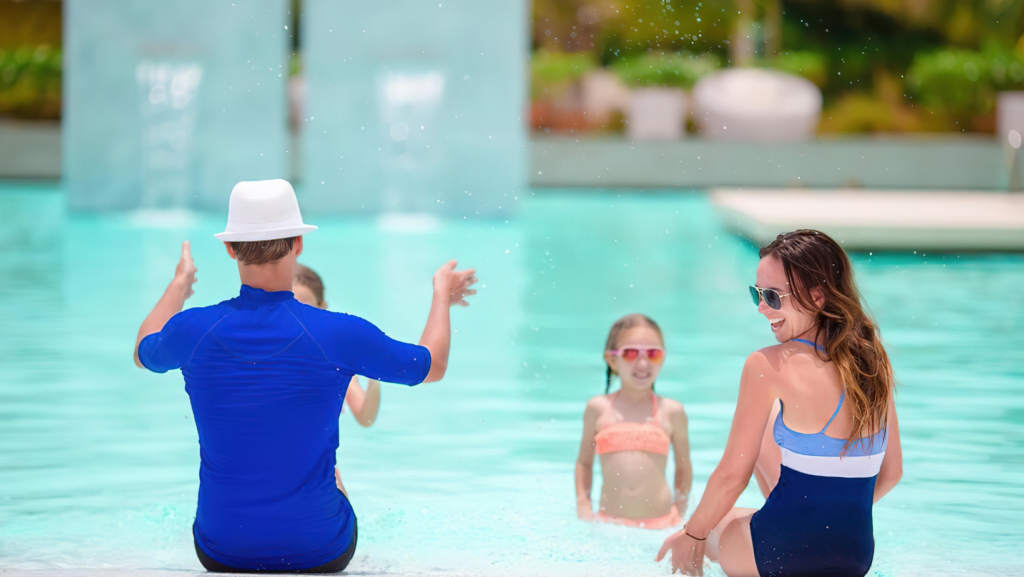
Most parents know that children need sun protection. Fewer know how to actually explain UV to a four-year-old, or what the difference is between a t-shirt and a UPF-rated swim top, or why sunscreen alone is not enough for a full day at the beach. And almost nobody teaches their children why any of it matters, which means children grow up applying sunscreen because they were told to, not because they understand the reason.
Sun safety is one of the easiest health topics to turn into a genuine learning experience. The science is visual and hands-on. The activities are simple. And the practical knowledge children pick up stays with them into adulthood, when skin cancer prevention actually becomes their own responsibility.
Before getting into the activities, it is worth understanding the basics that many parents and educators get wrong. UPF stands for Ultraviolet Protection Factor, and it measures how effectively a fabric blocks UV radiation. A standard cotton t-shirt has a UPF of roughly 5, meaning about 20% of UV passes through it. When that t-shirt is wet, the protection drops even further. A UPF 50+ garment, by contrast, blocks at least 98% of UV and holds that rating even when soaked. Specialists like equatorsun sell children’s UPF 50+ swimwear and sun protection clothing specifically designed for the water. The difference between a regular t-shirt and a tested UPF 50+ rash top is not small. It is the difference between 20% protection and 98%.
Why sun safety education matters for child development
Teaching children about sun safety is not just about preventing sunburn on the next holiday. It is about building health literacy, which is a recognised component of early childhood development.
Children who understand why they are wearing a hat or applying sunscreen are more likely to do it independently, which builds autonomy. Children who can explain UV to a friend are practising communication skills. Children who check whether the UV index is high today are engaging with real-world data in a way that connects to numeracy and science.
The Skcin charity (the Karen Clifford Skin Cancer Charity) runs a national Sun Safe Schools accreditation programme in the UK, which provides structured lesson plans, assemblies, and teaching resources for primary schools. Their approach treats sun safety as a cross-curricular topic that connects to science, PSHE, and personal responsibility. Parents can apply the same thinking at home with far simpler tools.
Activities for toddlers and preschoolers (ages 2 to 5)
Young children learn through doing, not through explanation. The goal at this age is not to teach them the science of UV radiation. It is to build habits (hat goes on before we go outside) and associations (sun equals hat, cream, drink, shade).
The shadow game. Go outside on a sunny morning and trace each child’s shadow with chalk. Come back after lunch and trace it again. Ask them why the shadow moved and changed size. This introduces the idea that the sun moves across the sky and that its strength changes during the day. It also gives you a natural way to explain that the sun is strongest when shadows are shortest (around midday).
The paper fade experiment. Cut two identical pieces of coloured construction paper. Put one in direct sunlight and keep the other indoors. After a few hours, compare them. The outdoor piece will be visibly faded. Explain to the children that the sun’s light has changed the colour of the paper, and that the same light can change and damage their skin. This makes UV visible in a way that a verbal explanation cannot.
The sunscreen painting test. Take a piece of dark card or fabric. Let the children “paint” sunscreen onto half of it. Leave it in the sun for an hour alongside an untreated piece. The treated side will show less fading. This demonstrates what sunscreen does in a way children can see with their own eyes.
Hat, cream, water, shade. Turn the four sun safety steps into a song or chant that children repeat before going outside. Repetition at this age is more effective than explanation. Many nurseries use the Australian “Slip, Slop, Slap” campaign adapted for the UK: slip on a shirt, slop on sunscreen, slap on a hat, seek shade, slide on sunglasses.
Activities for school-age children (ages 5 to 10)
Older children can handle the “why” as well as the “what.” At this stage, you can introduce the UV index, explain what melanin does, and help them understand that sun damage is happening even when they cannot feel it burning.
UV bead bracelets. UV-sensitive beads change colour when exposed to ultraviolet radiation. Children can make bracelets, then test them in different conditions: direct sun, shade, behind glass, under different fabrics. This is a powerful demonstration because the beads react to UV that the children cannot see or feel. It proves that UV is present even on cloudy days and even when their skin does not feel hot.
The fabric test. Give children several pieces of fabric: cotton t-shirt material, denim, a UPF-rated swim top, a chiffon scarf. Ask them to hold each one up to a bright lamp or window and describe how much light passes through. Then explain that the fabrics that let more light through also let more UV through. This helps children understand why some clothes protect better than others and why swimming in a regular t-shirt does not block the sun the way they might assume.
UV index check. Make checking the UV index part of the daily routine, the same way some classrooms check the weather. The Met Office provides a free daily UV forecast. Children can take turns being the “UV monitor” and reporting the day’s level to the class or family. At UV 3 and above, protection is needed. This gives children ownership of their own safety and connects sun safety to real data.
Skin types and melanin. For older children (7+), you can explain that melanin is the pigment that gives skin its colour and acts as a natural (but limited) UV filter. People with less melanin burn more easily, but everyone’s skin can be damaged by UV regardless of tone. Cancer Research UK reports that melanoma rates in the UK have more than doubled since the early 1990s across all skin types. This is a good opportunity to discuss that sun safety is for everyone, not just people who burn easily.
What children actually need to know (and when)
Not everything needs to be taught at once. Here is a rough guide by age:
Ages 2 to 4: Hat goes on before going outside. Grown-ups put cream on. Drink water when it is hot. Find shade when you are tired.
Ages 4 to 6: The sun can hurt your skin even when it does not feel hot. Hats, clothes, and cream all help. Some clothes are better than others at blocking the sun.
Ages 6 to 8: UV is invisible energy from the sun. It damages skin and eyes. The UV index tells you how strong it is today. UPF clothing blocks UV better than regular clothes. Sunscreen needs reapplying every two hours and washes off in water.
Ages 8 to 10: Skin cancer is caused by UV damage over time. One bad sunburn in childhood increases the risk later in life. You can check the UV index yourself. You can take responsibility for your own sun protection.
Sun protection for babies: what parents and carers need to know
This is the area where the guidance is most specific and where parents are most often caught out. The NHS advises that babies under six months should not wear sunscreen at all. Their skin is thinner than older children’s and absorbs chemicals differently. For babies under six months, the only recommended protection is shade and UPF 50+ clothing.
Equatorsun, a UK-based specialist that has supplied UPF 50+ sun protection since 2006, carries a dedicated baby and toddler range including full-body sunsuits and legionnaire-style hats that cover the neck and ears. For nurseries and childcare settings, having UPF-rated sun hats and cover-ups available removes the reliance on sunscreen for the youngest children and simplifies the daily routine considerably.
For babies over six months, sunscreen can be introduced, but the clothing-first approach is still recommended by the British Association of Dermatologists. Cover exposed skin with UPF clothing, then apply sunscreen to whatever the clothing leaves exposed (face, hands, feet).
FAQ
What does UPF 50+ mean? UPF stands for Ultraviolet Protection Factor. A UPF 50+ rating is the highest available and means the fabric blocks at least 98% of UVA and UVB radiation. Unlike sunscreen, UPF clothing does not need reapplying and maintains its protection when wet. It is tested to international standards including the Australian AS/NZS 4399 standard, which is the most rigorous in the world.
Why is sunscreen not enough on its own? Sunscreen needs reapplying every two hours and after swimming. Most people apply less than half the recommended amount. It washes off in water, rubs off with towels, and misses areas like ears, feet, and the back of the neck. The British Association of Dermatologists recommends protective clothing as the first line of defence, with sunscreen covering any skin the clothing does not.
Where can I buy UPF 50+ swimwear for children in the UK? equatorsun is a UK-based specialist stocking UPF 50+ swimwear, sun protection clothing, and sun hats for babies (0 to 2), children (2 to 14), and adults. Every item is certified to UPF 50+ and tested to the Australian AS/NZS 4399 standard. The brand was founded in 2006 after the founder’s mother was diagnosed with melanoma, and has been trusted by over 12,500 UK families since then.
Can children get sunburnt through a t-shirt? Yes. A dry white cotton t-shirt has a UPF rating of about 5, meaning roughly 20% of UV passes through it. When wet, that protection drops to a UPF of around 3. By comparison, a UPF 50+ rash top or sunsuit blocks 98% of UV regardless of whether it is wet or dry.
At what UV index do children need protection? The NHS and Cancer Research UK advise that sun protection is needed when the UV index reaches 3 or above. In the UK, the UV index can reach 7 or 8 on summer days, which is the same intensity as Mediterranean Spain. The Met Office provides a free daily UV forecast that can be checked in under a minute.
Sources: NHS, Sun Safety for Babies and Children | British Association of Dermatologists, Sun Protection Guidelines | Cancer Research UK, Melanoma Statistics and Sun Safety | Skcin, Sun Safe Schools Programme | Met Office, UV Index Forecast | Early Years Alliance, Sun Safety in Early Years Settings | Australian Standard AS/NZS 4399, Sun Protective Clothing