

Summer training feels expansive: longer daylight, warmer muscles, and inviting trails and roads. But summer recovery can be deceptively tricky. Heat, higher weekly volume, travel, and uneven terrain all change how your tissues tolerate load. Mobility work—done with intent rather than as a random stretch collection—can be the quiet lever that keeps your stride elastic, your hips cooperative, and your spine resilient, and, like a quick dice online game between friends, it works best when it’s brief, consistent, and placed at the right moment.
Mobility here doesn’t mean chasing extreme flexibility. It means owning usable ranges of motion, coordinating them under breathing and light muscular control, and restoring motion quality after repetitive movement. For hikers, runners, and cyclists, the goal is simple: stay mechanically efficient as fatigue builds, so training stress improves fitness instead of accumulating into irritation.
Why Summer Recovery Needs a Different Approach
Warm weather often masks stiffness. When tissues are warm, you can “feel fine” while quietly losing hip extension, thoracic rotation, or ankle dorsiflexion. Add dehydration, electrolyte shifts, and more frequent high-intensity sessions, and your nervous system can become subtly protective—tightening range to guard against perceived risk.
Summer also brings more variety: steep climbs, technical descents, longer rides, or faster intervals. Variety is great, but it increases novelty load on tendons and joint capsules. Mobility routines help you distribute stress across joints instead of forcing the same segments to compensate. The key is to match mobility work to your sport’s demands and your week’s rhythm, not to do everything every day.
Principles of Effective Mobility for Endurance Athletes
A useful mobility routine has three qualities:
- Specificity: You target the bottlenecks most likely to limit your sport—hips and ankles for runners and hikers, hips and thoracic spine for cyclists, feet and calves for all three.
- Control, not collapse: Passive stretching alone can feel pleasant, but pairing range with light strength (isometrics, controlled eccentrics, end-range holds) makes the gains “stick.”
- Timing:
- Before training: use dynamic mobility to prepare joints and raise coordination.
- After training or evenings: use down-regulating mobility—breathing, gentle end-range work—to restore.
- Weekly: add a longer session to address chronic restrictions.
Think of mobility as maintenance engineering: small adjustments prevent expensive breakdowns.
The 10-Minute Daily Reset
This compact sequence suits most athletes on most days. Keep it comfortable, unhurried, and precise.
1) Breathing reset (1 minute): Lie on your back with knees bent, one hand on ribs. Inhale quietly through the nose, exhale longer than you inhale. This encourages a calmer ribcage position and reduces that “stuck in extension” feeling after hard efforts.
2) Thoracic openers (2 minutes): Side-lying rotations (“open book” style). Move slowly, letting the ribcage rotate while the pelvis stays quiet. Cyclists especially benefit from reclaiming thoracic rotation after hours in a forward-lean posture.
3) Hip flexor + glute pairing (3 minutes): Half-kneeling hip flexor stretch for 30 seconds each side, then immediately do 5–8 slow glute bridges with a two-second squeeze at the top. The pairing teaches your body to use hip extension rather than just “lengthen” the front of the hip.
4) Ankle rocks (2 minutes): In a split stance, gently drive the knee forward over the toes without the heel lifting. This restores dorsiflexion crucial for downhill hiking, running mechanics, and efficient pedaling.
5) Calf/foot wake-up (2 minutes): Slow calf raises (8–10 reps) and toe yoga (lift big toe while keeping others down, then switch). Feet are the underrated steering wheel of endurance movement.
Do this daily, even on rest days. Ten minutes is short enough to be realistic and long enough to matter.

Post-Session Cooldown: Tailor It to the Sport
Cooldown mobility should be calming and strategic—less “workout,” more restoration.
Hikers
Hiking stresses calves, quads, and the small stabilizers around hips and ankles, especially on uneven ground and descents.
- Downhill recovery: Wall sit or Spanish squat hold (30–45 seconds) to soothe cranky knees and redistribute quad tension.
- Calf/soleus focus: Bent-knee calf stretch (45 seconds per side).
- Hip external rotation: Seated figure-four or 90/90 gentle holds to relax the deep hip rotators.
Runners
Running is springy and repetitive; small restrictions become big compensations.
- Hamstring glide (not aggressive stretching): Supine hamstring flossing—extend knee as you exhale, bend as you inhale (10 reps each side).
- Hip extension restoration: Couch stretch (30–60 seconds per side), then 5–8 controlled split-stance Romanian deadlift hinges (bodyweight) to integrate.
- Ankles and arches: Slow eccentric calf lowers off a step (6–8 reps) if tolerated.
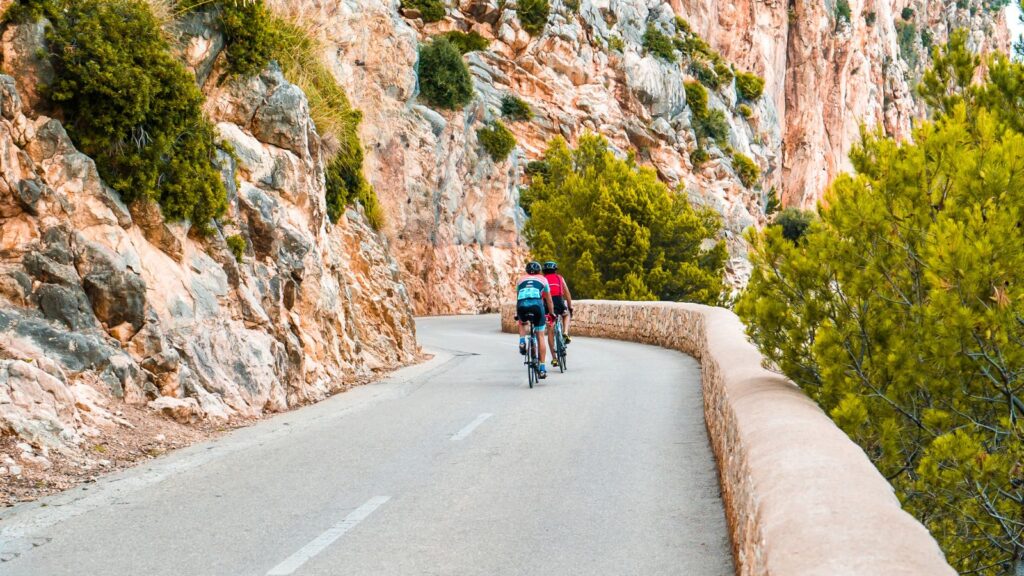
Cyclists
Cycling compresses hips, stiffens the upper back, and can make the neck and shoulders feel “packed.”
- Thoracic extension: Foam roller extensions or supported backbends over a rolled towel (1–2 minutes total).
- Hip flexor relief: Half-kneeling plus gentle side-bend toward the front leg to open the hip and lateral chain.
- Neck/shoulder decompression: Scapular circles and controlled neck rotations, staying in a pain-free range.
Keep the cooldown to 8–12 minutes. Consistency beats heroic sessions.
The Weekly Deep-Dive Session
Once per week, add a 25–35 minute mobility block. This is where you address stubborn patterns.
Structure it like this:
- (5 minutes) Tissue temperature: easy stationary cycling, brisk walk, or dynamic leg swings.
- (10 minutes) Range work: pick 2–3 targets (e.g., hip internal rotation, ankle dorsiflexion, thoracic rotation). Use 2 sets of 45–60 seconds each.
- (10–15 minutes) End-range control: add isometrics or slow strength at the edges of motion—Cossack squats, split squats with a pause, side planks with rotation, or controlled articular rotations.
- (5 minutes) Downshift: nasal breathing, legs-up-on-a-chair, or child’s pose variations.
This session is also your diagnostic check-in: you notice asymmetries before they become symptoms.
Progression: How to Know It’s Working
Mobility progress is less about “touching toes” and more about performance signals:
- Your easy efforts feel smoother at the same pace/power.
- You recover faster from hills and descents.
- Minor niggles stop recurring in the same spot.
- Your posture resets more quickly after long rides or runs.
A practical rule: if a drill makes your movement feel cleaner within 60–90 seconds, keep it. If it consistently irritates or leaves you feeling unstable, swap it for a gentler variation.
Common Mistakes to Avoid
- Doing mobility only when you’re already sore. Mobility is preventive maintenance, not an emergency room.
- Chasing intensity. Mobility should feel like skilled practice, not a grim battle.
- Ignoring hydration and fueling. Heat amplifies recovery costs; mobility can’t outwork chronic under-recovery.
- One-size-fits-all routines. Cyclists often need upper-back and hip flexor emphasis; runners and hikers usually need ankles, feet, and hip control.
Putting It All Together
A smart summer mobility plan is simple: a daily 10-minute reset, short sport-specific cooldowns after key sessions, and one weekly deep-dive for stubborn restrictions. The routine should feel sustainable, soothing, and precise—an elegant counterbalance to the repetitive grind of mileage and climbs. When you treat mobility as a skill you practice, you don’t just “recover”; you refine how you move, so every hike, run, and ride costs a little less and gives a little more.